For years, humanoid robots have looked great in lab demos and viral clips. This month one of them clocked in somewhere far less forgiving: a live car factory.
On November 10, 2026, Google DeepMind introduced Gemini Robotics 2.5, its newest AI model for controlling robots. Alongside it came a headline number: in a proof of concept with Apptronik and Mercedes-Benz, Apollo 2 humanoid robots reached a 96% success rate on real production lines. Here is what actually happened, why it matters, and why the remaining 4% may be the most interesting part of the story.
What happened, in plain words
- Where: active Mercedes-Benz production lines in Kecskemét, Hungary, and Sindelfingen, Germany. Not a lab, and not a staged set.
- Who: Google DeepMind (the AI), Apptronik, the Austin-based maker of the Apollo 2 humanoid (the body), and Mercedes-Benz (the factory). Mercedes is also an investor in Apptronik.
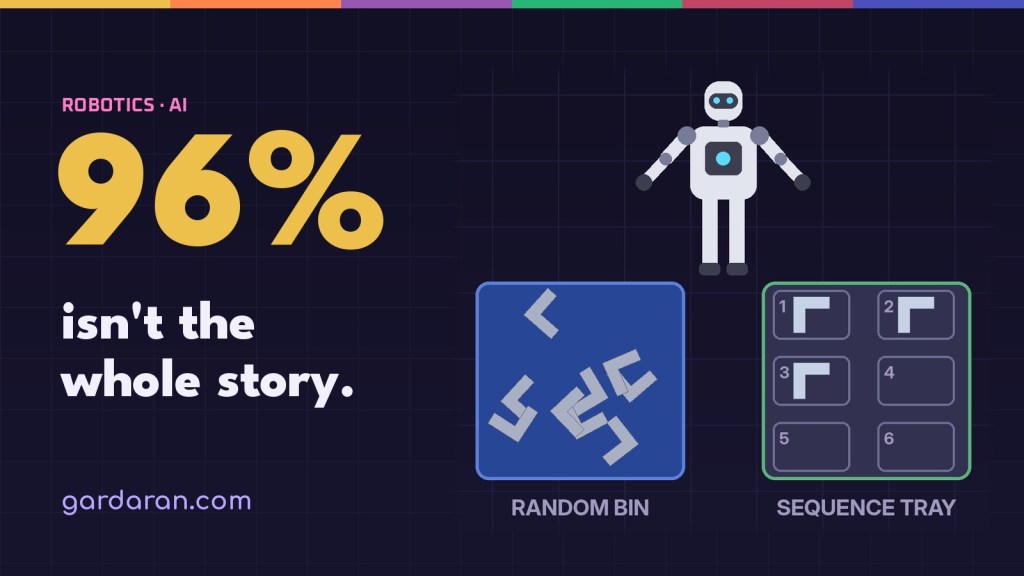
- The job: “kitting.” The robot picks metal brackets out of bins filled at random and places them into sequencing trays, in the exact order each car coming down the line needs them.
- The result: a 96% success rate, as reported by Google DeepMind.
Kitting sounds boring. That is exactly why it matters. It is repetitive, physically tiring and messy, because parts never sit in the same position twice. Classic factory robots hate that kind of mess. They need parts presented perfectly, which means expensive fixtures and re-engineering every time something changes.
How the robot “thinks”: two AI brains
The interesting technical idea is that the work is split between two models:
- Gemini Robotics ER (the planner): tracks the multi-step workflow, watches progress and works out how to recover when something goes wrong.
- Gemini Robotics 2.5 (the hands): a vision-language-action model that turns what the robot sees into precise arm and finger movements.
Think of it as a supervisor and a skilled worker sharing one body. Google says the new model completes tasks faster than its predecessor and shows big jumps in success across more than 200 tasks, with some tasks going from almost never working to working most of the time. Apptronik says the models improved dramatically within a few weeks of extra training and carried over to the Mercedes-Benz lines with very little drop-off.
Why this is a big deal
1. Robots that adapt instead of being programmed. Traditional industrial robots follow exact scripts. An AI-driven humanoid can, in principle, be retrained for a new task with data and practice instead of months of re-engineering. That is the real promise of “physical AI.”
2. Human-shaped robots fit human-shaped factories. Factories are built for people: aisles, shelves, bins and workstations at human height. A humanoid can slot into an existing line without rebuilding it.
3. The car industry is the proving ground. Car makers run some of the most demanding production lines in the world. If humanoids can earn a place there, warehouses, logistics and electronics assembly are next in line.
The 4% problem nobody is talking about
96% sounds amazing until you think like a factory manager. A production line cannot pause. If one pick in 25 fails, someone has to notice and fix it, and a missing bracket can hold up a car. Human workers doing the same job are close to error-free. So 96% is a huge step for robots, but probably not yet good enough for full production.
A few other honest caveats:
- DeepMind itself calls this a proof of concept, not a fleet running at scale.
- Key numbers have not been published: how many attempts were made, how often a human had to step in, cycle times, maintenance and cost compared with conventional automation.
- Gemini Robotics 2.5 is rolling out to selected robotics partners only, including Apptronik, Agile Robots and Boston Dynamics. There is no public access yet.
Still, this test was much tougher than a lab demo: real bins, real parts, real sequencing and the everyday chaos of a working factory.
What about safety?
Alongside the model, DeepMind released an open safety benchmark called ASIMOV-Jailbreak. It tests whether robot AI can be tricked into unsafe physical actions, the robot equivalent of “jailbreaking” a chatbot. As AI moves from screens into machines that can lift and move things, this kind of testing matters a lot more.
Will robots take factory jobs?
Not tomorrow. The near-term picture is robots taking the most repetitive, physically draining tasks, with people supervising, handling exceptions and doing the work that needs judgment. The bigger long-term question is speed: if a robot can learn a new task in weeks instead of being reprogrammed over months, automation will spread much faster than before. That is worth watching closely.
Our take
For years, humanoid robots were impressive demos looking for a job. This is one of the clearest signs yet that they are starting to find one. The 96% figure is not the finish line, but it is the first time a general-purpose humanoid has shown reliable results on a real production line. Watch for three things next: whether the success rate climbs toward 99%+, whether Mercedes expands the pilot beyond these two plants, and whether other car makers follow.
What do you think: would you trust a humanoid robot to build your next car? Tell us in the comments.
📺 Want the 60-second version? Watch our Shorts on YouTube and follow us on X, Instagram and Facebook for weekly AI and future-tech news.
Sources: Google DeepMind, Interesting Engineering, Automate.org, Humanoids Daily.


Leave a Reply